Thursday, 30 July 2026

THE WAIT IS FINALLY OVER – DEMON SLAYER: KIMETSU NO YAIBA INFINITY CASTLE I IS NOW STREAMING ON CRUNCHYROLL AND AVAILABLE TO BUY ON DIGITAL TODAY


WHAT:
Demon Slayer: Kimetsu no Yaiba Infinity Castle I is now streaming on the Crunchyroll platform.
 
Following its explosive theatrical run during its release last summer, the feature-length film is now available in both Japanese with English subtitles as well as dubbed in English.
 
Additional dub languages include: Latin American Spanish, Brazilian Portuguese, French, German, Italian, Castilian Spanish, Catalan, Russian, Hindi, Tamil, Telugu and Thai, as well as Polish voiceover. Subtitled languages include: Latin American Spanish, Brazilian Portuguese, European Portuguese, French, German, Italian, Castilian Spanish, Arabic, Russian, Polish, Thai, Chinese, Vietnamese, Indonesian and Melayu.
 
Demon Slayer: Kimetsu no Yaiba Infinity Castle I is also now available to purchase in select territories including North America on the Apple TV app, Prime Video, Google Play*, YouTube, and Fandango.
 
WHEN:
Streaming now
 
WHERE:
Crunchyroll, where fans can also rewatch all episodes of Demon Slayer: Kimetsu no Yaiba and the previous film Demon Slayer -Kimetsu no Yaiba- The Movie: Mugen Train. Also available to stream are the special live orchestral performance Demon Slayer: Kimetsu no Yaiba -Orchestra Concert- and the live stage performance Demon Slayer: Kimetsu no Yaiba ON STAGE.
 
Film Synopsis:
Tanjiro Kamado – a boy who joined an organization dedicated to hunting down demons called the Demon Slayer Corps after his younger sister Nezuko was turned into a demon.
 
While growing stronger and deepening his friendships and bonds with fellow corps members, Tanjiro has battled many demons with his comrades – Zenitsu Agatsuma and Inosuke Hashibira. Along the way, his journey has led him to fight alongside the Demon Slayer Corps’ highest-ranking swordsmen, the Hashira, including Flame Hashira Kyojuro Rengoku aboard the Mugen Train, Sound Hashira Tengen Uzui within the Entertainment District, as well as Mist Hashira Muichiro Tokito and Love Hashira Mitsuri Kanroji at the Swordsmith Village.
 
As the Demon Slayer Corps members and Hashira engaged in a group strength training program, the Hashira Training, in preparation for the forthcoming battle against the demons, Muzan Kibutsuji appears at the Ubuyashiki Mansion. With the head of the Demon Corps in danger, Tanjiro and the Hashira rush to the headquarters but are plunged into a deep descent to a mysterious space by the hands of Muzan Kibutsuji.
 
The destination of where Tanjiro and Demon Slayer Corps have fallen is the demons’ stronghold – the Infinity Castle. And so, the battleground is set as the final battle between the Demon Slayer Corps and the demons ignites.
 
Credits: Original story by Koyoharu Gotoge (JUMP COMICS / SHUEISHA). Directed by Haruo Sotozaki. Screenplay and animation production by ufotable.

Tuesday, 25 April 2017

Malawi official jailed for nine years over Cashgate scandal - Video Dailymotion

Malawi official jailed for nine years over Cashgate scandal - Video Dailymotion: Cashgate Scandal Malawi has the power to transform the winner’s career and both the Man Booker Prize and Man Booker International are sponsored by Man Group. Man Group was recognised as a partner who mirrored the quality, integrity and longevity of the Booker Prize. The prize underscores Man Group's charitable focus on literacy and education as well as the firm’s commitment to excellence and entrepreneurship.

Wednesday, 22 February 2017

History of the Projector

we eat, breathe, and live presentations. We also acknowledge that our unusual lifestyles would never have existed without the projector: The Mother of All Presentations. Let’s pay our respects by learning a bit more about the projector.


An Ancient History

Projecting images onto a larger surface is an old trick; the first known instance of this was recorded in a drawing by Johannes de Fontana in 1420. In which, a nun holds a lantern with a small translucent window that projects an image of a devil. Leonardo da Vinci also drew a similar device, later known as a magic lantern, in 1515.


But who invented the actual, official magic lantern? And when? To find out the truth, you will need a time machine and a boxing ring to let all of these potential inventors fight it out:

Pierre Fournier – 1515, France

Giovanni Battista della Porta – 1589, Italy

Athansius Kircher – 1646, Germany

Christiaan Huygens – 1659, Holland

Thomas Rasmusser Walgenstein – 1660, Denmark

Claude Millet – 1674, France

These early projectors were often used for devious purposes, nicknamed “lantern of fright” because they were adopted by magicians to “summon ghosts” or appear in two places at once. Not exactly the stuffy tools of boardrooms we use today.

Getting Civilized

In the late 1800s, magic lanterns using oil lamps began to be adopted by photographers, lecturers, and the general public rather than the spooky magician crowd.  They were also wisely renamed “opaque projectors.” As time progressed, incandescent light bulbs with halogen lamps took the place of outdated light sources. These opaque projectors (as we know) were great teaching tools. For example, Chicago’s public school system had around 8,000 opaque projectors by the end of World War I.

Overhead projectors eventually replaced the opaque projector. In World War II, soldiers were trained from presentations using a version of an overhead projector. Through the 50s and 60s, schools, businesses, and even police departments relied on overhead projectors to share information.

Our Fancy Future

Overhead projectors evolved into multimedia projectors when digital images took over in the 20th century. On May 22nd, 1990, Microsoft launched a slide-based presentation computer program. We know it today as our beloved PowerPoint, though it was originally called “Presenter” by developer Dennis Austin.

The goal of PowerPoint was to have a number of pages or “slides” that could represent the transparencies used in an overhead projector. It was more efficient than other forms of visual aid such as whiteboards or chalkboards, and served many kinds of audiences and presentation needs. The projector game had changed forever, signaling the end of overhead projectors and physical slide sheets.


Today you can buy portable, wireless, and digital projectors for less than you might spend on a good pair of jeans. However, we still tip our hats to the projectors of yesteryear, and all the ingenuity it took to create them.

Tuesday, 26 July 2016

Want a job? Here’s some conflicting advice!


In lecture halls around the world, university departments and organizations with names like “Employment Soon!” are hosting career panels, presumably with the goal of making graduate students and postdocs freak out. They invite a handful of gainfully employed scientists, give them microphones, and then let the arbitrary information flow.

The audience includes trainees who may have never technically held a job in science, despite having worked in academic labs for a decade or more. They’re all looking for the magical job market formula, the secret tip that will cause the offers to roll in. They may also be looking for bagels.

You can tell who the most panicked students are, because they frantically scribble every word a panelist or presenter says, as if waiting for them to whisper, “Format your CV in 11-point Arial Rounded MT Bold. That’s what they want to see.”

“But what about line spacing? What line spacing?”

“1.15.”

“I KNEW IT.”

If they’re not panicked when they enter the seminar room, they’re certainly panicked when they leave—because the advice is never straightforward, rarely general, and often contradictory.

At a job panel I attended this spring, one panelist warned that you should never connect with your interviewer on LinkedIn; it looks desperate. The students dutifully scribbled down this advice. Then it was the next panelist’s turn. She advised that you should definitely connect with your interviewer on LinkedIn—before the interview takes place, if possible. The scribbling stopped.

The panelists smiled at each other; this was going well. Meanwhile, I could hear the students’ brains: “Um ... can’t you just tell us how to get jobs?”

Here’s just a sampling of some of the other conflicting advice I’ve seen job panels offer.

    Dress formally vs. wear what you’d wear to work

We’re scientists. Our most important fashion accessories are the gloves that protect us from bacteria (or that protect the bacteria from us). No one advocates wearing sweatpants and a Jethro Tull T-shirt to a job interview, but at the same time, there’s a range of guidance on what to wear. A suit or just khakis and a nice shirt? Heels or flats? What makes me look like I’m trying too hard, and what makes me look like I’m not trying hard enough? We’d like to think that no one cares, but it’s “all part of the package,” as they say.

I once witnessed a discussion of a scientist’s job interview that factored in her purse. Because it was an expensive purse, apparently, the interviewers concluded that she was capable of doing the work but probably wouldn’t want to.

The best fashion accessory for you to bring to a job interview, then, is obviously a necklace with a long chain. Hold it up in front of your interviewers and let it swing gently back and forth. Once the hypnosis has taken hold say, “I am wearing exactly what you want me to be wearing.”

    Be personable vs. be serious

If you’re not serious, you’re not ready to perform science at a high level. But if you’re not jokey and jovial, you’re not someone with whom your potential co-workers will want to interact. If you’re either more serious or more personable than your future colleagues, they may feel threatened. And if you’re serious one moment and personable the next, then they’ll wonder, “What is wrong with this weirdo?”

    Be confident vs. be humble

Every recommendation for being successful in life contains some variant of “Be confident.” Look people in the eye. Don’t hedge. Don’t apologize. Step on your interviewer’s foot and say, “Yeah, I’ve got solid feet. WHAT.” But you also don’t want your confidence to make people wonder whether you’ll never admit to being wrong. I once interviewed an extremely confident man who said, “I’ve got a lot of great ideas, but I’m not going to give you all of them unless I get the job.” He then proceeded to tell me one idea for free, and it was one of the stupidest ideas I’d ever heard.

    Ask about salary vs. act like money is not important to you

The most awkward part of any job interview is the part you want to know the most: whether they check your internet browsing history. Just kidding, it’s the salary discussion—yet you can make it through multiple rounds of interviews with no information about the job’s salary beyond what you glean from hearsay and guesswork. Does asking about it make you look practical, or does it communicate that you’re focused on the wrong thing? It’s especially frustrating because a lot of nonscience jobs declare their pay scales outright, while a lot of science jobs withhold the information. And if there’s anything scientists love, it’s using numbers to make decisions.

    Negotiate your salary vs. that’s not done

If you’ve never negotiated a salary before, you may be picturing something like haggling inside a spice hut in Marrakech, Morocco—with bargains, concessions, and at least three or four repetitions of the phrase “It’s a good price.” In reality, every company is different. Some hiring managers will laugh and high-five each other after you leave the room if you accept their first offer, while others will simply shrug at you and say, “That’s what the job pays.”

    Talk about outside interests vs. pretend you have none

No one wants to hire a scientist who only cares about science. But no one wants to hire a scientist who spends all of her or his time in lab writing an Appalachian banjo blog. (Then again, I don’t think anyone wants to interact with a person who spends all their time writing an Appalachian banjo blog.) And sometimes, the guidance falls somewhere in the middle: Talk about outside activities, but show that each one somehow complements your science. “Where do I plan my experimental protocols?” you might say. “Well, I usually get my best ideas while paragliding.”

    Embrace your graduate research vs. pretend you’re better than that

Those with graduate degrees have a special challenge: You’ve spent the last several years working on a project, and you can probably describe that project with unique commitment and thoroughness. By discussing your graduate research at length, you’re showing that you can become an expert on a given topic and generate data. But if you talk about your graduate research too much, your potential employer will see you as a permanent graduate student, not someone ready to take the next step. In other words, graduate school has set you up to fail. Yay graduate school.

    Don’t show too much interest vs. don’t show too little interest

“I want this job, but I don’t need it,” your attitude should convey, when in reality you want it, need it, and would likely put on a koala costume and dance the Macarena if it meant you’d get health insurance. (Twenty years ago, I actually had a job that required me to put on a koala costume and dance the Macarena. It did not include health insurance.) This conflict highlights the most exasperating aspect of finding a job: All of the power is with the hirers. They can indulge their whims, while you have to court and coddle them as though they may flip out at any moment, like you would with a psychotic codependent lover—or a normal toddler.

Of course no piece of advice works for all jobs, or all job seekers. But do job panels really have to be as tone-deaf and insensitive to their audiences as they sometimes are? It’s as if the moment we get jobs, we forget what it was like on the other side of the table, and we feel we can give any old instructions because they’ll all be fine.

Maybe the reason for the conflicting advice is that there isn’t one right answer, and all we know is what worked for us. Panelists want to feel helpful, so if one of them wore blue to a successful interview, he or she will recommend wearing blue.

So when you attend a science job panel, take everything with a grain of salt. Listen to the panel’s recommendations, and then use your own judgment to parse the unhelpful bits. Because one of the worst things you can do is to let the panel’s contradictory ideas stymie you until you’re trapped endlessly formatting and reformatting your CV based on the last suggestion you heard.for more info, check out avant career

Wednesday, 6 April 2016

4N/5D Udaipur to Mount Abu Tour Packages

Udaipur Tourism & Rajasthan India Travel Guide - City of Lakes, Temples & Wonderful Traditions - Visit This Amazing City of Rajasthan & Spend Few Days in the Lap of Nature & Culture. Travel Udaipur, Rajasthan & North India Guide For a Memorable Holidays of a Lifetime.

Duration: 04 Nights / 05 Days

1. Udaipur


You will be received by our representatives from the Jaipur Airport / Railway Station / Bus Stand.Upon arrival transfer to Hotel and have lunch. In evening Visit local Market and Fatehsagar Lake. In evening have a Traditional Marwar Dinner.

2. Udaipur

  
 After breakfast start the sightseeing travel of Udaipur. Visit Jagdish Temple, Sahelion-Ki-Bari, Garden, Maharana, City Palace, Lake Pichola. After the whole day of visit Stay overnight at hotel in Udaipur.

3. Udaipur-Mount Abu
  
After Early Breakfast you will be traveling towards MOUNT ABU. You will be taken sightseeing straight away. You will be visiting Mount Abu Lake, Sunset Point. Overnight Stay in Hotel.


4. Mount Abu
  
After Breakfast you will be taken to Guru shikhar, and other place of interest and the Overnight Stay in Hotel.

5. Mount Abu
  
After Breakfast you will be taken to local market for Shopping and later will drive back to Udaipur then will be dropped at nearest Airport/Railway Station/Bus Stand.


Highlights of Udaipur to Mount-Abu Ex

    1. Udaipur- Sahellion Ki Bari, Beautiful Garden, Sagar Lake, City Place.
    2. Mount-Abu- Dilwara Temples, Sunset Point, Nakki Lake, Gaumukh Temple, Museum & Art Gallery.


Sunday, 13 March 2016

Medieval Orthodox Boyana Church

Boyana Church is a beautiful Medieval Orthodox Church located in Boyana Quarter set in the outskirts of the capital of Bulgaria- Sofia. Originally built in the late 10th to the early 11th century, the Boyana Church was expanded a few times, in the 13th century by Sebastocrator Kaloyan, as well as in the mid 19th century. The Boyana Church houses exquisite frescoes which are one of the most complete and perfectly preserved monuments of east European medieval art. It was included in the UNESCO World Heritage Site in1979, together with two more Bulgarian sights- Madara Rider and Kazanlak Tomb.


The frescoes of Boyana Church were made in 1259. They were in fact the second later, painted over original artwork done in the earlier centuries. There are a total of 89 scenes with 240 human images painted on the frescoes. The name of the artist, as discovered during restoration, was one "zograph Vassilii, from the village of Subonosha, Sersko, and his apprentice Dimitar". As for the 11th-12th century original frescoes, only fragments were preserved, as it is the second later done in 1259 which is the more famous. In addition, the church also houses later work done in the 14th, 16-17th centuries, as well as those from 1882. The oldest section of the Boyana church is the one-apse cross-vaulted chapel built in the late 10th to early 11th century.

To this, the ruler Sebastocrator Kaloyan added an annex in the mid 13th century. The annex is a two-floor tomb-church, with the ground floor holding the family sepulchre, and the upper floor the family chapel. The newest section of the church was built in the mid 19th century from funds donated by the surrounding community. This place is one of the most visited by the tourists traveling to Sofia, together with the Historical Museum and the "St. Nevski" Cathedral Church.

Medieval Orthodox Church, Boyana Church, UNESCO World Heritage, Bugaria tourist attraction, Historical Museum

Ancient City of Nessebar

Nessebar is charming town located in the southern Black Sea coast and is one of the most popular Bulgarian Black Sea resorts. It is divided into two parts determined as "The New "and "The Old" city. The Old City is the preferred part, while the new one is more specified in accommodation service.

The old Nessebar in fact is located on a small peninsula connected to the mainland by a thin piece of land. The first thing which will welcome you is a big wooden windmill. Soon after, you will meet the stone walls of the ancient city. The old city of Nessebar is quite popular with its historical churches
 and buildings dating back to ancient times.


For this reason this town is included in the list of UNESCO World Heritage Sites. Originally a Thracian settlement, the Nessebar was later a Greek polis, then a Roman colony. The largest number and best known buildings date from 11th to 14th centuries almost all of them churches in the so called "picturesque" style: walls intersected by pilasters and lunettes, with stone, brick and ceramic ornaments and arches along the cornice. According to legends, the churches of Nessebar were no less than 41, which, when compared to the small population of the town, make the latter one of the world's settlements with the highest number of churches per capita.

One of the oldest sanctuaries is the Basilica built on the coast most probably around the beginning of 5th century. The Old Bishop's Residence located in the centre of the town is probably the most impressive church in Nessebar. It is more than 25m long and 22m wide while its three naves were decorated with a colonnade and arches. St. Ivan the Baptist Church was built much later, in the 11th century. It is a typical cross-domed church with three naves, and four columns supporting the dome. There you can see fragments of frescoes dating back to the 13th century.

The St. Stefan Church or the so-called New Bishop Residence, situated in the vicinity of the harbor, was built in the 10th century. Its decoration is so picturesque that it marked the beginning of a typical local style, seen in the construction of churches of later times. If you are tired of sightseeing the summer resort of Sunny Beach is only 2km. away.


Thursday, 3 December 2015

Beauty of Nagarjuna Sagar Dam

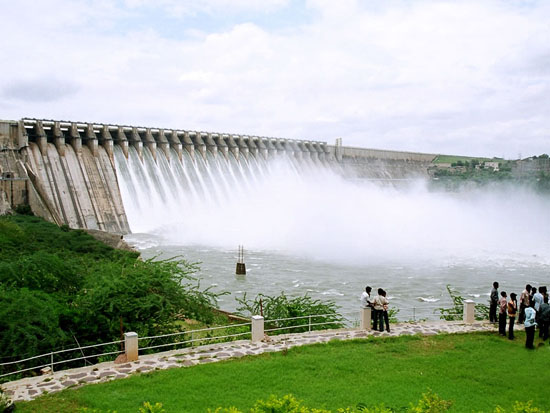
Nagarjuna Sagar dam is one of the most visited site in Telangana by young and old alike. Nagarjuna Sagar dam currently holds the record of being the tallest masonry dam (that is, a dam made by way of masonry and is of either gravity or arch type) in the world. Standing at a height of 124 meters, a length of 1 kilometer, and holding back 11,742 million cubic liters of Krishna River water, it is not really surprising if one starts to feel a rush of sheer awe and insignificance when standing before such a massive marvel of architecture and engineering.

It also happens to have created the worlds third largest man-made lake, creating a reservoir that plays a very vital role in the irrigation of vast tracts of land in the surrounding region.

Nagarjuna Sagar Dam is located 150 kilometers from Hyderabad, on the Krishna River, straddling the borders of Nalgonda and Guntur districts. The dam itself provides irrigation to four districts, namely Nalgonda, Guntur, Khammam and Prakasam; the total land it covers goes more than 10 lakh acres.


Construction of the dam started in February of 1956, but it was hampered due to the scarcity of funds for the procurement of modern machinery. As a result, stone instead of concrete was used. To expedite the construction, a cement factory was created near Macherla, a municipality in the Guntur district, and a railway line was erected to connect the factory to the construction site. Stones were supplied from nearby quarries in Sunkesula, while sand was obtained from Halia river and Rayavaram stream. The project was finally completed in 1969, and full usage of the dam came in 1972 after the crest gates were fit in. All in all, around 1300 crore rupees was spent on the dam, including the maintenance up until 2005. There were between 45,000 to 70,000 workers who participated in the construction of the dam.

Aside from the dam itself, there are other attractions nearby as well. The Nakarjunda Konda Island lies in the middle of the lake, containing the historical remnants of a Buddhist settlement that was relocated there during the dam construction.

Friday, 9 October 2015

Desert National Park Jaisalmer

Desert National Park is one of the major national parks, having an area of 3162 km². It is a brilliant sample of the ecosystem of the desert silt form about 20% of the Park. The main land form comprises of rugged stalwarts and dense brackish lake ends, inter modal regions and static mounds. Desert National park Jaisalmer Rajasthan is one of fantastic sanctuary all over India.

Even with a delicate ecological unit there exist a plenty of bird life. The area is a shelter for migratory and inhabitant fowls of the desert, a lots of eagles, harriers, falcons, buzzards, kestrel and vultures. Short-toed Eagles, Tawny Eagles, Spotted Eagles, Laggar Falcons and kestrels are the very common amongst these. Sand grouse are marked close to the trivial pools or ponds. The threatened Great Indian Bustard is a superb birdie existed in comparatively reasonable quantities.

It travels nearby in diverse time of year. The most appropriate time to stopover the region is in the middle of November and January. The Park has a group of remnants of faunas and floras of 180 million years ancient. Some remnants of Dinosaurs of 6 million years ancient have been originated in the area.


Best Time To Visit- Detailed Information

The best time to stopover National park Jaisalmer Rajasthan  is between the months of October to March, even though the town remains busy with travelers all through the year. Yet, in mid summers there are probabilities one might get affected with heat blow.

Distance From – National Park


The distance of the park from jaisalmer is around forty kilometers. The park is located at a distance of 300 kilometers from the airport of Jodhpur.

How To Reach There

By Airways


However Jaisalmer is not straight linked to Airways, Jodhpur airport which is 300 Km away, is linked to all the main cities of India through government possessed as well as reserved air company. From Jodhpur one can take rental Cabs or a train trip as per desire and preference.

Things To Do In – National Park

Jeep Trip allows travelers to discover a broader area of the park in comparatively little time. Likewise, it is extremely fascinating to see the inclusive variety of plants and animals from the jeep.

Camp out is possibly the finest way to relish the fauna of the park. Though, travelers must thought the delicate flora of the park and therefore abstain from affecting any kind of injury to it.


Sudashri, a wood landmarker situated in the park, is the greatest place for seeing the flora and fauna of the Desert National Park and delivers perfect environments for photographs.

A wonderful bird, the great Indian Bustard, can be grasped in significantly big numbers. It wanders in the vicinity in diverse time of year. The area is a paradise for traveling and local birdies of the desert. One can grasp several Eagles, Harriers, Falcons, Buzzards, Kestrel and Scavengers. Small- toed Eagles, Tawny Eagles, Speckled Eagles, Laager Falcons and Kestrels are the most common among these.

Keoladeo National Park & Bird Sanctuary, India

The Keoladeo National Park or Keoladeo Ghana National Park was formerly called as the Bharatpur Bird Sanctuary in Bharatpur of the state of Rajasthan in India. This park is famous as the avifauna sanctuary that congregates thousands of the species of birds and especially during the winters. This park is the habitat for more than 230 species of birds. This park is also popular among the tourists as well as the ornithologists who generally visit this park during the hibernal season. In 1971 this park was declared as the protected sanctuary as well as the World Heritage Site.

Keoladeo Ghana National Park is one of the men made National park as well as the wetland of India that is being managed by men. This park helps in the protection of Bharatpur from regular floods and also provides the grazing grounds for the local village cattle. This park was used as the waterfowl hunting ground by the people.

This forest reserve of about 29 km (18 mi) area is locally known as Ghana that is the assortment of dry grasslands, woodland swamps, woodland and wetlands. This park provides the These sundry habitat for about 366 species of birds, about 379 species of flora, 13 species of snakes, about 50 species of fishes, 7 species of amphibians, 5 species of lizards, 7 species of turtle and many species of other invertebrates.

Best Time To Visit

Best time to visit this park is in the months of November to March


Distance From – National Park

Jaipur airport is the only nearest airport that is available from this park. Many flights for Mumbai, Varanasi, Lucknow and Delhi can be taken from this airport. The other second nearest airport is the Delhi airport. Bharatpur junction is the nearest railway station that is about 5 km from this park. There are many good roads that connect Bharatpur from other parts of India.

Visitors can also use their own vehicles for traveling. Bus services are also available from various big cities like Delhi (184 km), Jaipur (176 km), Mathura (39 km), Alwar (117 km) and other surrounding areas. Bharatpur is the stoppage for many long route trains like from New Delhi (New Delhi – Mumbai and Agra – Jaipur route). Bharatpur is easily reached by train or bus, although private taxis from New Delhi or Agra can be employed. The Park gate is close to the bus stand and railway station.

How To Get There

Bharatpur of Rajasthan is situated in the south west side of New Delhi on NH- 11. Bharatpur is being connected by the road to Agra (60km), New Delhi(175 km via Fatehpur Sikri and Agra) and Jaipur (180 km). There are many express trains that start from New Delhi (N Delhi – Mumbai and Agra – Jaipur route) have their stoppage at Bharatpur. One can reach Bharatpur very easily by boarding the train or bus. The private taxis are also available from New Delhi and Agra. The main gate of this park is very close to the railway station as well as the bus stand of Bharatpur.


Things To Do In – National Park

The best time for the visitors to visit this park is between months of October to February when the visitors can see a variety of the migratory birds. During the period other than above it can also be visited after poor monsoon. However at this time this park is dry and bird-free.

Due to the popularity of this park as the habitat of various species of the nesting as well as the migratory birds in the world, near about 100,000 visitors visits this every year. The visitors include the outside visitors, Ornithologists and the students of the school and colleges as well. Out of the total visitors the number of the foreign tourists is about 45,000 per year.

The number of visitors is also too much as the people who come here for visiting Agra, Fatehpur Sikri and Jaipur also use to stop here in Bharatpur for visiting this park. The park remains open whole year round from morning to evening.

For the foreign the ticket is for Rs.200 and for the Indian Visitors the ticket is Rs.25. Visitors can also take their vehicles up to the Shanti Kutir that is about 1.7 kilometers inside the park by paying Rs. 50 per vehicle.

After Shanti Kutir you can move further by walk, bicycle or by cycle rickshaw, Tonga. Boats can also be used if the water level is high. There are the cycle rickshaw wallah having the yellow plates on their rikshaws shows that they are the authorized one and also the guides having binoculars. There is also the provision of the packed lunch by the hotels. There is also the canteen on the second gate of the park where one can take a bite and also at the Forest Lodge.

Thursday, 16 July 2015

Bandipur National Park a Mesmerizing and Enchanting Place

Now a days  everyone wish to have a  relaxing break away from the hustle and bustle of city life and always in search charming tourist attractions. Here is the great place teeming with wildlife and natural beauty that will make your holiday a blissful days. “Bandipur National Park” welcomes you with a diverse flora, fauna, outstanding scenic beauty and spanning area of 874 square km.

Bandipur National park is located in Gundlupet taluq of Chamarajanagar district in the South Indian state Karnataka. This fascinating tourist destination is among the India’s first Tiger Reserves created in 1973 under the Wildlife Protection Act. Formerly it was about 90 acres reserve forest but due to insufficient place it was expanded to 800 acres in 1941 and named as Venugopala National park and now it is contiguous with Madhumalai wildlife Sanctury in Tamil Nadu and Nagarhole National park in the north west.

Climate :

This park is a part of Nilgiri Biosphere reserve which known as first biosphere of India. The typical tropical climate keep an average temperature above 18°C in every month of the year and feature wet and dry seasons. Nagu river which flows through the middle of the park adds extra beauty where as the Kabini and Moyar river respectively flows in north and southern area.


What to see:

If you are much fond and wildlife enthusiastic then it going to be a  memorable for sure because of an opportunity to experience animals in their natural habitats.

Wildlife

To explore the park’s beauty and enjoy the jungle ride you can hire Forest department’s  jeep and other vehicles. This park is house of around 3000 Elephants which are highlight of park. them very close at the roadside . Many of the animals and spices of birds found in the park including  Tiger, Panther, Wild dog, Sloth Beer, common Langur, Deer, Gaur, Wild Boar, Sambar, Antelope.


Gopalaswamy Betta :

This highest peak in the Bandipur national park which covered with fog for most part of the year is at a 1454 m above the sea level offers a stunning views of surrounding forest. There is also a temple dedicated to Lord  Venugopala (Lord Krishna) at  top of the hill. It can access through a road near the Hangala village.  

How to reach :

By Air : Closest airport  to  Bandipur National park is Bangalore which is 258 km . Here you can get cab,taxi on rent . Clear Car Rental is one of the major car rental service provider at there.

By Rail : There in no railway station in Bandipur but Mysore is nearest railhead at a distance of 78 kms from where you can pick up a taxi for your journey.

Precautionary steps for wildlife safari :

- Stay in your vehicle.

- Enjoy wild animals by keeping appropriate distance from them.

- Do not feed any animals.

- Do not carry any alcoholic beverages during trip.

- Wear comfortable and natural shade clothes.

Latest Top Links:

RMOS

HR Manager-Sr. HR Recruiter in RMOS LTD

2015 Rmos Jobs

RMOS LTD - Careesma

RMOS Consultancy is in which area of gurgaon ?

Rmos Ahmad Profiles

Rmos Service Provider in Gurgaon Sector 14

RMOS Consultancy Profile connection with blogger profile

Rmos - Placement India

RMOS's Presentations on authorSTREAM

RMOS LTD Jobs - TimesJobs

RMOS | India's largest Outsourcing Recruitment Company

Rmos Jobs in India

Wednesday, 20 May 2015

Beautiful Place Cape town Iconic City

Cape Town is the iconic city where Nelson Mandela made his first speech as a free man. Nestled on the shore of Table Bay, the city was also named this year’s world design capital. Boasting of Mediterranean-like climate, the city is just perfect for some beach selfies, and Boulder’s Beach is one of the few spots in the world where you can share your selfie with some penguins.


Thursday, 9 April 2015

Sultan Hassan Mosque

The Sultan Hassan Mosque and madrasa (School) is considered stylistically the most compact and unified of all Cairo monuments. The building was constructed for Sultan Hassan bin Mohammad bin Qala'oun in 1256 AD as a mosque and religious school for all sects. It was designed so that each of the four main Sunni sects (orthodox Muslim, or Sunni rites, consisting of Shafite, Malikite, Hanefte and Hanbalite) has its own school while sharing the mosque. The cornices, the entrance, and the monumental staircase are particularly noteworthy.

The madrasa was originally introduced to Egypt by Saladin to suppress non-orthodox Muslim sects. There is a difference in congregational as opposed to Madrasa style Mosques such as the Sultan Hassan. While some congregational Mosques have been used as schools, those designed for that purpose generally have smaller courtyards (Sahn) and the buildings are more vertical, allowing for classroom space.


Many consider the Sultan Hassan Mosque to be the most outstanding Islamic monument in Egypt. It is of true Bahri Mameluke origin, built of stone, and while it is entirely different in design, it shares a like boldness to the Ibn Tulun Mosque.

There is no architectural indulgence here, but rather self confidence in its clarity of execution and restraint. In allowing separate schools for the four Sunni rites, the Sultan Hassan is based on a classical cruciform plan, meaning that the Sahn opens from each of its sides into a separate liwan, which is an enormous vaulted hall, each serving one of the rites.

While the design of liwans predates Mohammed (Peace and Prayers Be Upon Him), it was the Mamelukes who arranged them in the Cruciform manner, and as in the Sultan Hassan Mosque, advanced this architecture with the addition of a domed Mausolea. However, this Mausolea is empty, for Sultan Hassan died several years prior to its completion.

Structurally from the outside, the Mosque is very impressive, holding its own with its impressive cornice and the protruding verticals of its facade, even though it stands in the shadows of the massive Citadel. As one enters the Mosque from Sharia el Qalaa, there is an impression of height, especially from the towering doors decorated in a Mameluke fashion. Even during the Mameluke error in Cairo, building space was at a premium. Thus the outer walls are somewhat askew, in order to fit the available lot, but these designers had a wonderful way of creating the impression of uniform cubistic effect inside regardless.

Wednesday, 1 April 2015

Top 5 Indian Travel Portals of 2015

goworldtravel.in - Back in 2003, goworldtravel took a giant leap of faith. goworldtravel started a full-feature travel magazine and decided to publish it exclusively online. It was a stretch for goworldtravel, a group of print journalists whose usual joy came from seeing goworldtravel words in newsprint or on the glossy pages of magazines.

TheTravelBoss.com - TheTravelBoss.com is a travel directory that many people should find not only useful to their travel agendas, but helpful in deciding where to go and who to stay with. If you take a look around the website then you will see that there are plenty of categories for travelers to look at if they are interested in finding out more information about where to go and which companies to do business with


traveltorch.com - With almost 12 years, traveltorch at Compare Infobase Limited have extended our services to various domains and it stepped in the arena of e-magazines with the launching of Travel Torch. traveltorch exploration in diverse fields has been the main motivation behind developing this monthly magazine.

lonelyplanet.in - Lonely Planet is renowned for its first-hand approach, up-to-date maps and commitment to providing the best information for travellers.

cntraveller.in - Condé Nast Traveller is world's leading luxury travel brand. Through its magazine, website and social media channels, Conde Nast Traveller provides over 4,00,000 readers premium travel inspiration and information.